
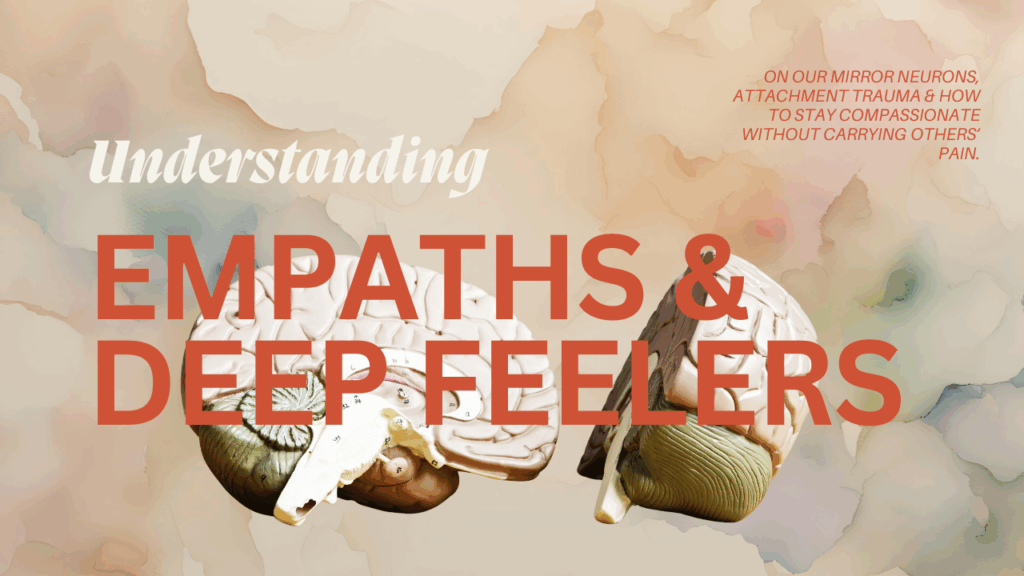
There are days when empaths, deep feelers, highly sensitive people, and therapists like me sit with someone, and before we even realize what’s happening, our body begins to ache in the same place theirs does.
Our chest gets heavy. We start to feel tension headaches, our neck tightens, or our eyes fill with tears, mirroring the deep sadness in theirs. It’s as if our nervous system opens its doors and says, “Come in; feel at home.”
This sensitivity, like Spidey-senses or seismographs, helps us see beneath words and notice subtle shifts, movements, and emotional tremors. But it also comes at a cost. There might be days when we leave a conversation carrying more than we arrived with. The weight of stories, emotions, and small, invisible heartbreaks lingers in our bodies like echoes that take hours, or even days, to fade.
Sometimes, we might struggle with this because even though things seem fine in our own lives, we still feel a deep ache or weight. Sometimes, we can’t even identify what’s happening. We just feel something inside.
For me, this happens when I think about my clients or the people I love and how they might be doing.
For a long time, I thought this meant I was ruminating, perseverating, or living life in someone else’s world. But I’m slowly learning more about the brain, about empathy, sensitivity, and emotional fusion through neuroscience and attachment theory, and both offer a kinder explanation.
Mirror Neurons (The Simulation System) and the Insula (The Interoceptive Hub)

Inside all of us lives a network called the mirror neuron system, a set of brain cells that light up not only when we act but when we witness someone else act. When a person’s face softens or their shoulders tremble, those same neurons in us quietly imitate the motion. Our brain rehearses what others are feeling.
Then the insula, deep in the folds of the brain, takes that signal and translates it into sensation. It’s what allows us to feel another’s sadness, not just understand it.
The body becomes a mirror: our pulse, breath, and temperature syncing to someone else’s emotional rhythm.
When your mirror neurons pick up someone’s subtle affect, your insula translates that into a visceral sensation: a tight chest, a heavy stomach, heat behind the eyes.
So the combination of a highly tuned mirror system and a very active insula creates what’s called affective resonance—you don’t just recognize another’s emotion; you embody it.
For most people, this happens at a distance. But for those of us who grew up in homes where silence was the signal, that boundary can dissolve.
Family Conditioning: The Fawning Adaptation
I, like many of my clients, come from a family where conflict meant disconnection. Where emotions were swallowed, buried, or turned into a long and heavy quiet.
In that silence, I learned to listen differently, to watch micro-expressions, the tremor in a voice, the space between words, the sighs of disappointment. I became attuned to what others were thinking or feeling, constantly scanning for moods and gestures.
What I now understand as hypervigilance and fawning once felt like intuition and love.
As described by Pete Walker, fawning is a trauma response where an individual tries to avoid conflict by becoming overly appeasing and people-pleasing towards others, often to a degree that they neglect their own needs and boundaries.
I was the peacemaker, the emotional translator, the one who sensed what others couldn’t name and tried to bridge gaps for them.
For many of us, chronic hypervigilance teaches the nervous system to scan faces, tones, and micro-expressions for threat or emotional disconnection.
This means our mirror–insula empathy loop can get wired early as a survival strategy. What was once adaptive, reading the room to avoid conflict, can become empathic over-absorption in adulthood.
All of this is a brilliant adaptation for survival, but it’s also exhausting. It’s sad. It often leaves us full of anxiety, helplessness, or grief, both others’ and our own.
When we grow up attuned to everyone else’s emotional weather, our own internal climate can feel uncertain. The line between empathy and enmeshment blurs. We begin to believe that feeling other people’s pain is how we show love and care.
But empathy isn’t meant to be absorption. It’s meant to be attunement: a dance between I see you and I am still me.
Returning to the Self
As a therapist, I’ve been practicing small rituals, drawn from neuroscience-based therapy tools, to help me return to myself. These are for anyone who feels deeply, who monitors and feels responsible for other people’s emotions.
- When emotion rises in the chest that might not be ours, try to name it: I feel a weight in my heart; something is moving through me. Find where that feeling lives in the body, give it shape, and breathe.
- When tension appears, ground into neutral sensations. Come back to your feet on the floor, the weight of the chair beneath you. Let yourself return to your own life, your hobbies, your home, your pet, your partner, or even your plants.
- If you find yourself constantly thinking about people you love and feeling intensely, try cupping your hands over your eyes. Breathe, applying gentle pressure to the base of the skull. Release the tension in your eyes. Imagine exhaling the residue of emotional resonance into that small bowl of air, then letting it go.
- When you feel the pull to rescue, to soothe, to fix, remind yourself: I can witness this without owning or needing to fix it. Compassion doesn’t require absorption. Presence doesn’t require solutions. Sometimes the best we can do is check in, listen, and say, I love you. I’m here for you.
- Lastly, move to release. A good run, a walk, lifting weights, yoga, gentle stretches, or vagal tone/somatic exercises all help the body discharge what it holds.
These practices are quiet and simple, but they teach our body what our mind already knows. That love and empathy are strongest when they’re not fused with fear.
That we don’t have to monitor or control others’ emotions to feel safe. That we can orient our body to the present rather than the past.

In truth, the sensitivity that once kept us safe is also what allows us to connect deeply—to feel the hum of another person’s humanity in our own heartbeat. It doesn’t need to be exiled. It just needs to be balanced.
Maybe this is the work of a lifetime: learning to sense another’s sorrow without drowning in it, to hold space without losing our own.
It’s learning that we can stand beside someone in the storm, umbrella in hand, and still know which rain is ours.
In Closing
If you, too, find yourself feeling the emotions of others as if they were your own, I’d love to help you explore this tenderness with curiosity and care.
In our work, we will explore therapy for empaths and highly sensitive people while also processing the trauma and grief that come with this experience. We honor both the science of the nervous system and the poetry of our lived experience. Together, we can learn how to listen deeply without losing ourselves, and to make space for both the ache and the aliveness that come with being human.